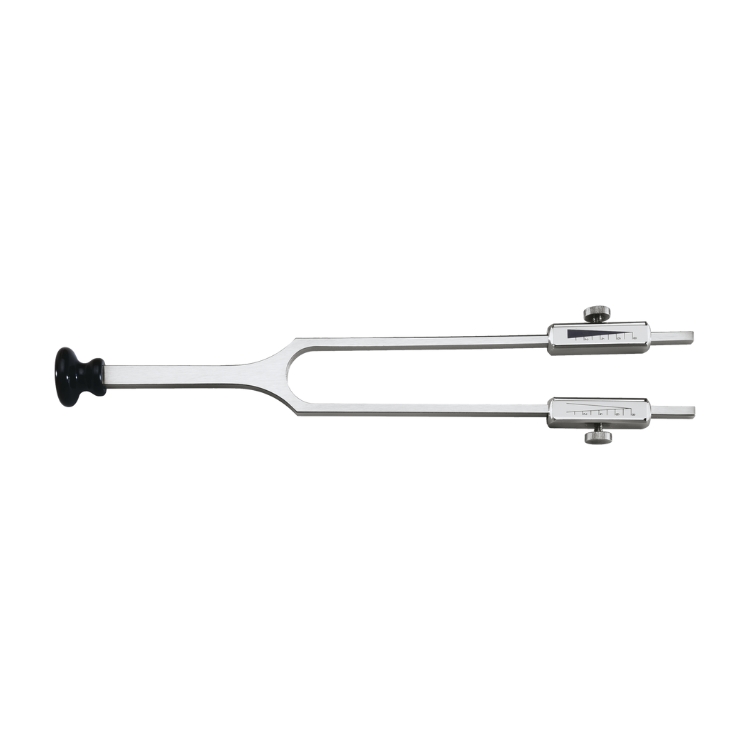
Precision tuning fork for vibration sensitivity testing.
The Rydel-Seiffer Tuning Fork is a specialised diagnostic instrument used to evaluate vibration sensation, particularly in patients with suspected peripheral neuropathy, including diabetic polyneuropathy. With a length of 23.5 cm, the device is engineered to deliver precise, quantifiable vibration feedback, enabling practitioners to identify diminished or lost sensitivity with a high degree of reliability. This tuning fork is an essential tool in podiatry, neurology, endocrinology and general medical examinations where early detection of neurological impairment is critical.
Hold the tuning fork by the stem and strike one prong gently against a rubber pad or your hand to initiate vibration.
Observe the Rydel-Seiffer scale markings as the fork vibrates.
Place the vibrating end on bony landmarks such as the hallux interphalangeal joint, malleolus, tibia or other relevant test points.
Ask the patient to indicate when the vibration sensation is no longer felt.
Compare the reading with standard values to assess sensory function.
Repeat on both limbs for comparison and documentation.
Measures vibration perception to detect sensory loss.
Supports early identification of diabetic polyneuropathy.
Provides quantitative and reproducible diagnostic values.
Helps differentiate between peripheral nerve dysfunction and normal sensory function.
Assesses neurological integrity in the feet and legs.
Highly reliable assessment of sensory neuropathy.
Standardised and widely recognised diagnostic tool.
Easy to use and suitable for all clinical settings.
Lightweight and durable for long-term use.
Enables early diagnosis of foot-related neuropathies, improving prevention strategies.
Provides objective data that can be recorded and tracked over time.
The Rydel-Seiffer Tuning Fork is an indispensable diagnostic instrument for clinicians who assess nerve function in the lower limbs. Its precision, ease of use and diagnostic reliability make it a key tool for the early detection of neuropathy—particularly in diabetic patients—helping practitioners implement timely interventions and improve long-term patient outcomes.