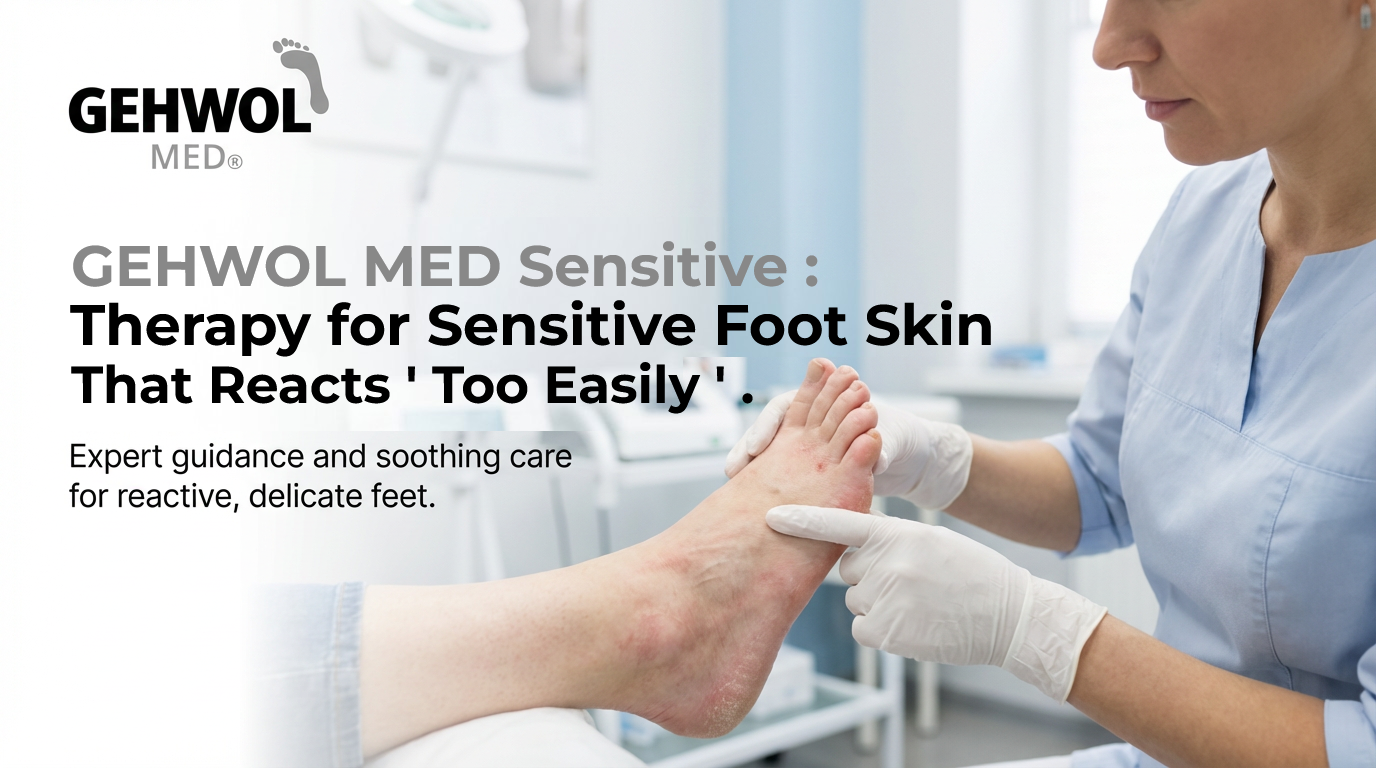
An evidence-led, practice-ready overview for podiatrists and dermatologists
Sensitive foot skin is rarely “just cosmetic.” In daily practice, you see it in patients whose barrier is compromised, whose microcirculation is reduced, or whose inflammatory threshold is simply lower—diabetes, atopic predisposition, neurodermatitis, recurrent irritation, post-treatment sensitivity, and more. The result is familiar: itching, burning, redness, dryness, fissures, and a skin surface that escalates from minor stress to flare quickly.
GEHWOL MED Sensitive Cream was designed precisely for this clinical reality: a triple-action approach that targets microbial irritation, neuro-sensory discomfort (itch/burning), and barrier repair—now in a micro-silver-free reformulation available since October 2025.
Why sensitive foot skin needs “more than moisturization”
Sensitive skin is defined by a weakened barrier, increased irritant penetration, and amplified sensory responses. Contemporary reviews describe three practical pillars for sensitive-skin relief:
- Barrier repair, 2) reducing TRPV1-driven stinging/burning, 3) anti-inflammatory support.
That same logic is built into the GEHWOL MED Sensitive positioning: stabilize barrier function, calm irritation symptoms, and support the skin’s resilience against daily triggers (shoes, temperature swings, friction, dryness, disease-related vulnerability).
What’s new in the 2025 formula and why it matters clinically
1) Micro-silver-free, aligned with current regulatory reality
GEHWOL MED Sensitive has been reformulated with an optimized micro-silver-free approach due to new EU regulation context and current evidence on sensitive-skin care. The new antimicrobial strategy relies on decylene glycol, described as a nature-identical substance with selective antimicrobial effects and improved compatibility.From a broader formulation-science perspective, glycols are widely recognized as multifunctional ingredients that can contribute to antimicrobial performance and formulation stability—an approach increasingly explored for infant/sensitive-skin cosmetic preservation strategies.
(Separately, safety assessments of 1,2-glycols used in cosmetics include dermal safety data for decylene glycol among others.)
2) TRPV1 modulation for stinging/burning and “reactive” discomfort
A standout choice in the complex is 4-t-butylcyclohexanol, used to reduce itching and burning sensations.
A peer-reviewed paper reports immediate anti-stinging/anti-burning effects for formulations containing 4-t-butylcyclohexanol, supporting its relevance for reactive/sensitive skin symptoms.
Recent dermatology literature also frames TRPV1 antagonism as a meaningful strategy in sensitive skin care.
3) Anti-inflammatory and soothing support (bisabolol + ginger root extract)
GEHWOL MED Sensitive includes bisabolol and ginger root extract for anti-inflammatory and soothing effects.
Bisabolol (classically associated with chamomile) has been extensively discussed in pharmacological reviews for anti-inflammatory activity and cosmeceutical use.
4) Barrier rebuilding with skin-identical lipids
The formula includes ceramides, cholesterol, and phytosphingosine to support barrier regeneration and reduce moisture loss.
This aligns with well-established barrier biology: the stratum corneum lipid matrix relies heavily on ceramides + cholesterol + fatty acids for barrier homeostasis, and ceramide abnormalities are implicated in barrier dysfunction states.
Why this matters specifically in diabetes and atopic predisposition
Foot skin in diabetes is frequently challenged by xerosis, pruritus, impaired barrier performance, and higher downstream risk from fissures and micro-trauma. Clinical and consensus literature highlights that xerosis/pruritus in diabetes can contribute to adverse events, and skin-barrier maintenance is a meaningful, practical target.
Research also associates foot fissures with diabetic ulcer risk factors and angiopathy/neuropathy associations—reinforcing why preventing dryness → fissures is not “optional.”
Clinical data: what GEHWOL reports and how to interpret it
GEHWOL MED Sensitive is described as clinically proven in a dermatologically controlled application study involving 50 subjects, including diabetics and patients with atopic predisposition, showing significant improvement after 4 weeks. Reported symptom reductions (itching, burning, dryness, redness) were up to 58%, with no undesirable skin reactions and tolerability rated very good.
An application test by EUROFINS is also referenced in the product documentation (see study and brochure in product description). For your practice, the key message is not “miracle cure”—it’s that this is therapy-supporting care designed around symptom relief + barrier support + compatibility in high-need groups.
Where GEHWOL MED Sensitive fits in your protocols
Podiatry: high-friction, high-risk feet
- Reactive, irritated foot skin from footwear stress + environmental dryness
- Diabetic patients with xerosis/itch + compromised resilience
- Barrier-repair support between visits and alongside preventive care
Dermatology: sensitive skin and barrier disease overlap
- Atopic predisposition and neurodermatitis (outside acute flare phases as supportive care)
“Burning/itching” dominant presentations where TRPV1-driven discomfort is part of the complaint
Patients seeking high tolerability without “over-treating” with pharmacologic escalation
Practical use guidance (clinic-friendly)
- Apply regularly as part of daily barrier care (especially after cleansing).
- Emphasize consistency: barrier repair is cumulative, not instant.
- In diabetes/neuropathy: pair with routine foot checks and early escalation for fissures, maceration, or infection signs.
(As always, avoid applying on open infected wounds unless you’re managing within an appropriate clinical pathway.)
Closing: a modern “sensitive foot skin” solution built for clinical reality
For podiatrists and dermatologists, GEHWOL MED Sensitive is best understood as a modern, multi-mechanism, therapy-supporting foot-skin care option—built around the realities of barrier dysfunction, microbial irritation pressure, and neuro-sensory discomfort.
If your patient group includes diabetes, atopic predisposition, neurodermatitis, or simply “feet that react to everything,” this is a product worth placing on your radar—especially given its clinical tolerability focus and barrier-first design.