
GEHWOL MED
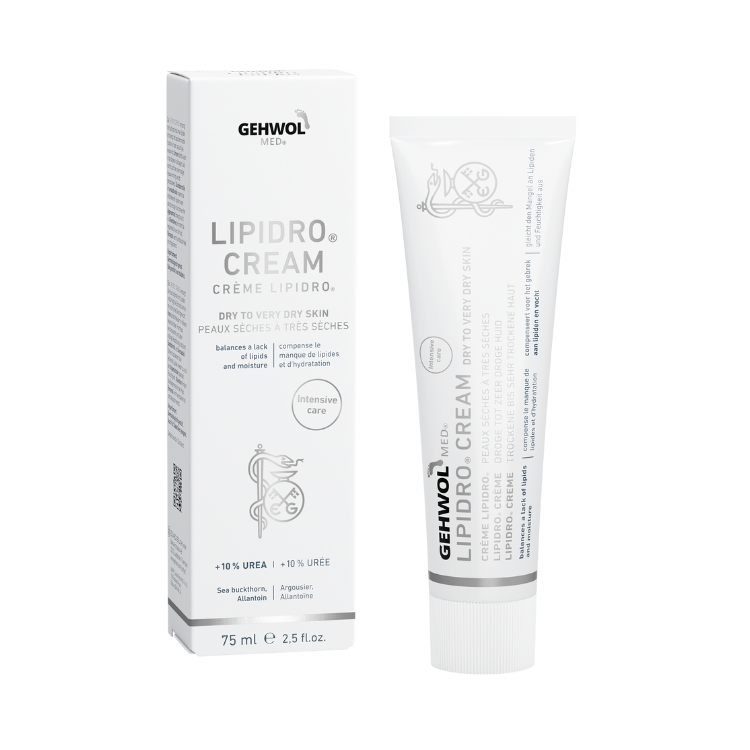
GEHWOL MED Lipidro Cream: A Clinical Guide to Lipid Barrier Restoration
For podiatrists and pharmacists in Cyprus Why Dry Skin on the Foot is a Medical Problem, Not a Cosmetic One The skin on the plantar
The skin on the plantar surface of the foot is among the thickest in the body — and among the most physiologically demanding. It must withstand continuous mechanical pressure, friction, and shear force across tens of thousands of steps daily, while maintaining an intact barrier against microbial invasion and transepidermal water loss. When that barrier fails, the consequences range from uncomfortable to life-threatening depending on the patient.
For a healthy patient, dry plantar skin is a cosmetic nuisance. For a patient with diabetes, peripheral arterial disease, or atopic predisposition, it is a clinical risk factor. Fissures that form in dry, inelastic heel skin create entry points for bacterial and fungal infection. In a foot with compromised circulation and impaired healing capacity, a minor fissure can progress to ulceration within days. This is the clinical context in which GEHWOL MED Lipidro Cream was developed — and it is the context in which podiatrists and pharmacists in Cyprus should be recommending it.According to the International Diabetes Federation, approximately 10.5% of the global adult population lives with diabetes — a figure that is significantly higher in Mediterranean populations. In Cyprus, the prevalence of type 2 diabetes is estimated at around 12-13% of adults, making diabetic foot care one of the most clinically important areas of professional practice on the island.
The skin’s lipid barrier — the outermost layer of the stratum corneum — is a lamellar structure of ceramides, free fatty acids, and cholesterol that regulates transepidermal water loss and provides the primary physical defence against environmental pathogens. When this lipid matrix is intact, the skin remains supple, resilient, and resistant to microbial colonisation. When it is depleted or disrupted, the skin becomes dry, inelastic, and vulnerable.
In the context of the foot, lipid barrier depletion occurs through several mechanisms. Diabetic autonomic neuropathy reduces sudomotor function — the sweat glands that normally contribute to surface lipid distribution stop working effectively, leaving the plantar skin chronically dry. Reduced peripheral circulation means fewer lipid precursors reach the skin. Chronic mechanical loading causes repeated micro-trauma that disrupts the barrier faster than it can be repaired. Age compounds all of these effects — elderly skin produces less natural moisturising factor and has a reduced capacity for barrier repair.
The clinical result is well documented. Research published in the Journal of Diabetes Science and Technology confirms that impaired skin barrier function in diabetic patients is directly associated with increased risk of foot ulceration — making barrier restoration a primary preventive intervention, not a secondary comfort measure.
GEHWOL MED Lipidro Cream is formulated around a triple-phase lipid emulsion — plant-derived phospholipids, urea at 10% concentration, and panthenol — designed to restore the lipid matrix of dry, depleted plantar skin at the cellular level rather than simply coating the surface.
Phospholipids are the primary structural components of the skin’s natural lipid lamellae. The plant-derived phospholipids in GEHWOL MED Lipidro Cream integrate into the existing lipid bilayer structure of the stratum corneum, physically restoring the barrier architecture rather than creating an occlusive film on top of it. This is a fundamentally different mechanism from petroleum-based emollients, which work primarily by reducing transepidermal water loss through occlusion without contributing to barrier reconstruction.
Urea at 10% concentration performs two functions simultaneously. As a humectant, it draws and retains water within the stratum corneum, increasing skin hydration and flexibility. As a mild keratolytic, it softens and loosens excess keratinised tissue, making it effective for managing callus margins and preventing the buildup of hard skin that leads to fissure formation. The 10% concentration is the clinical threshold at which urea transitions from purely humectant activity into meaningful keratolytic effect — high enough to be clinically effective, low enough to be tolerated by sensitive and fragile skin.
Panthenol (provitamin B5) is a well-established wound-healing and tissue-recovery active. It penetrates the stratum corneum and is converted to pantothenic acid, which supports epithelial cell regeneration and accelerates the repair of compromised skin. In the context of diabetic foot care, where the skin’s natural repair capacity is impaired, panthenol provides meaningful clinical support to the recovery process.
GEHWOL MED Lipidro Cream contains no fragrances and no colourants. This is not a marketing decision — it is a clinical one. Fragrance compounds are among the most common contact allergens, and atopic or sensitive skin — precisely the skin types for which this product is indicated — is disproportionately reactive to fragrance exposure. Recommending a fragrance-containing emollient to a diabetic or atopic patient introduces an unnecessary sensitisation risk. The fragrance-free formulation eliminates that risk entirely.
GEHWOL MED Lipidro Cream is indicated for any patient presenting with chronic plantar dry skin where standard consumer moisturisers have been inadequate. Specific indications include:
The recommended application protocol is as follows: apply a thin layer to the entire plantar surface and heel after bathing, when the skin is clean and slightly warm. In a professional podiatric setting, apply immediately following mechanical debridement or callus reduction — the freshly cleared skin surface will absorb the active ingredients more effectively than intact keratinised tissue.
For home care maintenance between appointments, recommend once daily application in the evening. For severe cases or patients with active fissures, twice daily application until the skin has stabilised, then once daily for maintenance.
When a customer presents with complaints of dry, cracked, or rough plantar skin, the clinical differentiation that determines whether to recommend a standard consumer emollient or GEHWOL MED Lipidro Cream is the severity and persistence of the condition. If the customer has already tried standard pharmacy moisturisers without adequate improvement, or if they are diabetic, elderly, or have a known skin condition, GEHWOL MED Lipidro Cream is the appropriate recommendation.
Key talking points for counter recommendations:
GEHWOL MED Lipidro Cream 75ml is available in Cyprus exclusively through Losayia partner pharmacies. Browse the full GEHWOL MED Lipidro Cream product page or explore the complete GEHWOL MED range on the Losayia partner portal.
Is GEHWOL MED Lipidro Cream safe for diabetic patients?
Yes. GEHWOL MED Lipidro Cream is specifically formulated for compromised skin conditions including diabetic foot syndrome. It is fragrance-free, colourant-free, and dermatologically tested, making it one of the most appropriate pharmacy foot care products for diabetic patients with chronic dry skin and compromised barrier function.
What is the difference between GEHWOL MED Lipidro Cream and a standard moisturiser?
A standard moisturiser works primarily by reducing transepidermal water loss through occlusion — it seals the skin surface but does not contribute to barrier repair. GEHWOL MED Lipidro Cream contains plant-derived phospholipids that integrate into the lipid bilayer structure of the stratum corneum, physically restoring the barrier architecture. Combined with urea at 10% and panthenol, it addresses barrier restoration, hydration, and tissue recovery simultaneously.
Where can I buy GEHWOL MED Lipidro Cream in Cyprus?
GEHWOL MED Lipidro Cream is available in Cyprus through pharmacies supplied by Losayia Co. Ltd, the official GEHWOL distributor in Cyprus since 1994. Healthcare professionals can access the product through the Losayia partner portal at losayiacoltd.com.
How often should GEHWOL MED Lipidro Cream be applied?
For daily maintenance, apply once in the evening after bathing. For active fissures or severely compromised skin, apply twice daily until stabilised. In a professional setting, apply immediately following mechanical debridement for optimal absorption into the freshly cleared skin surface.
For podiatrists and pharmacists in Cyprus Why Dry Skin on the Foot is a Medical Problem, Not a Cosmetic One The skin on the plantar